Blog
Getting Smoke Smell Out of a Car (Source First)
Air fresheners fail because the source is still releasing. Smoke residue settles into soft surfaces and the ventilation path — and both need addressing.
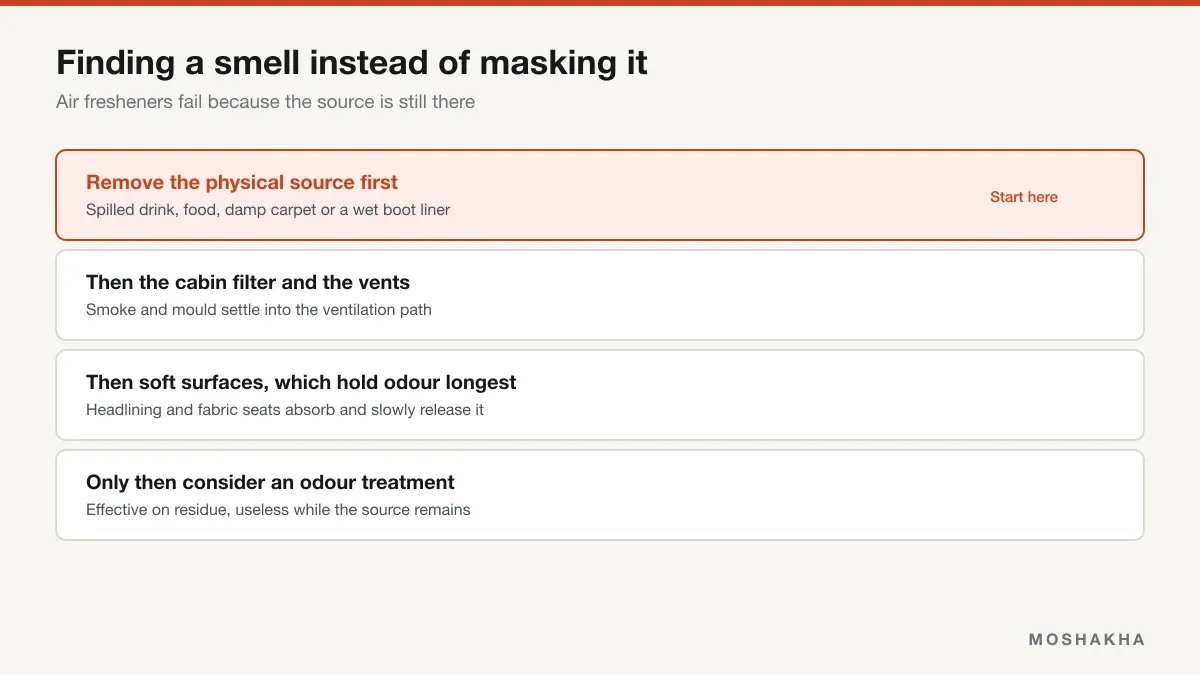
Smoke is the hardest odour to remove from a car because it isn’t really an odour — it’s a physical deposit that’s still releasing one.
Why fresheners lose
Smoke leaves tar and fine particulate on every surface it reached, and soaks into every porous one.
That deposit keeps off-gassing. An air freshener adds a competing scent on top of a source that’s still actively producing, which works for a few hours and then loses.
Every effective approach starts from the same place: remove the material, don’t cover it.
Work in source order
Soft surfaces first, and the headlining above all. Smoke rises, so the roof lining takes the heaviest deposit and is almost never cleaned. It’s the single most common reason a car still smells after a thorough seat-and-carpet clean.
Headlining needs care — the fabric is glued to a backing board and over-wetting can delaminate it. Damp the brush or cloth, never spray it directly, and work in light passes.
Then seats and carpet. Porous, high surface area, and they hold residue deep in the pile. Vacuum thoroughly first.
See the car vacuum we reviewedThe extraction technique matters here for the same reason it does with any fabric work — what you dissolve has to come back out rather than dry back in. That’s covered in cleaning fabric car seats.
Then hard surfaces. Dash, door cards, console, and the inside of the glass — the film on interior glass in a smoked-in car is substantial and holds odour.
Replace the cabin filter early
The filter sits directly in the air path and is saturated with exactly what you’re trying to remove.
Cleaning the whole interior and then running air through a contaminated filter reintroduces the smell to everything you just did. Do it early, not as a finishing touch — how to replace a cabin air filter.
Expect more than one round
For a heavily smoked-in car, one session rarely finishes it.
Clean, ventilate for a day or two, then reassess. Odour often returns as remaining residue off-gasses into still air — that’s information, not failure. The improvement between rounds tells you whether you’re reaching the source.
Two or three rounds is normal.
Ozone, with the caution attached
Ozone treatment is effective on residual odour once the physical cleaning is done, and it’s what professional detailers use for stubborn cases.
It is not a substitute for removing residue, and it carries a real warning: ozone is a respiratory irritant. The vehicle needs thorough ventilation before anyone gets in, and the treatment shouldn’t be run with people or pets anywhere near it.
Final step, never first. The same caution and the broader argument about air-quality gadgets is in car air purifiers: check the cabin filter first.
The same order works for any smell
Spilled milk, damp carpet, food left under a seat — the method doesn’t change. Find and remove the physical source, address the ventilation path, then treat what’s left.
Anything that starts with a fragrance is starting at the end.
Frequently asked questions
Why do air fresheners never get rid of smoke smell?
Because they add a scent on top of a source that's still releasing. Smoke residue is a physical deposit — tar and fine particulate that settled onto every surface and soaked into porous ones. Until that's removed it keeps off-gassing, so the freshener masks it for a few hours and then loses. Removing the residue is the only durable fix.
Which surfaces hold smoke smell the longest?
Soft, porous ones — the headlining above all, because it's directly in the smoke's path as it rises and it's rarely cleaned. Fabric seats and carpet come next, then the cabin air filter and the ventilation ducting. Hard surfaces hold residue too but release it quickly once wiped, which is why a car can smell fine after a surface clean and then smell again within days.
Does an ozone treatment work on smoke?
It can be effective on residual odour after the physical cleaning is done, and it's what professional detailers use for stubborn cases. It is not a substitute for removing the residue, and it carries a real caution: ozone is a respiratory irritant, so the vehicle needs thorough ventilation before anyone gets in. Treat it as a final step, not a first one.
How long does it take to remove smoke smell properly?
Longer than one session for a heavily smoked-in car. Expect to clean, then leave it ventilated for a day or two, then reassess — smells often return as remaining residue continues off-gassing into still air. Two or three rounds is normal, and the improvement between rounds tells you whether you're getting to the source.
Is it worth replacing the cabin filter for a smell?
Yes, early rather than late. The filter sits directly in the air path and traps particulate, so in a smoked-in car it's saturated with exactly what you're trying to remove. Cleaning the interior thoroughly and then running air through an old contaminated filter reintroduces the smell to everything you just cleaned.