Reviews
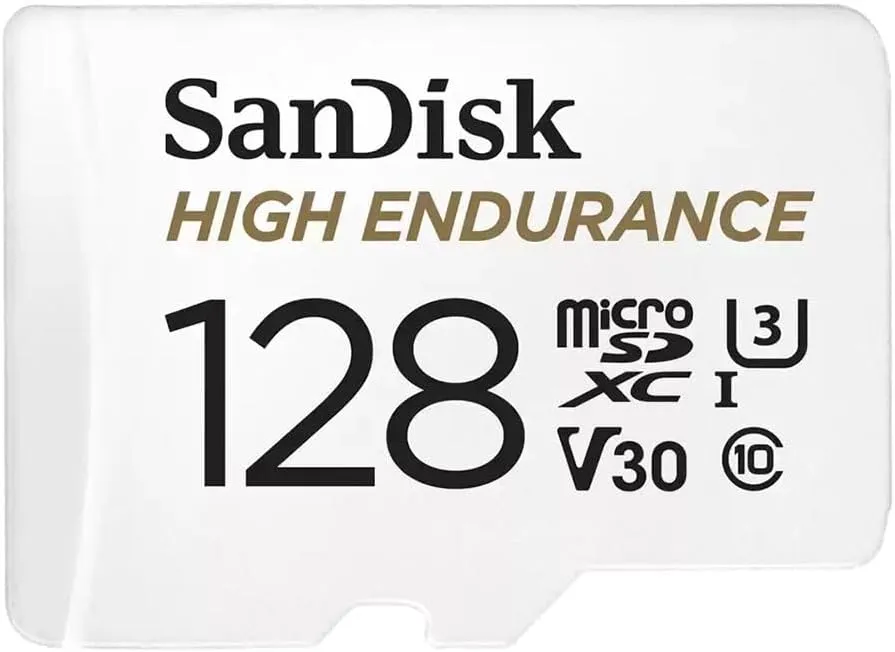
SanDisk High Endurance 128GB Review: Built to Be Overwritten
Dash cams destroy ordinary memory cards, and the failure is silent. What endurance rating actually buys, and why V30 matters more than the read speed on the front.
Moshakha is reader-supported. When you buy through links on our site, we may earn an affiliate commission at no extra cost to you. How we make money.
Pros
- Endurance-rated for continuous surveillance-style writing
- V30 guarantees sustained write speed, not just burst speed
- 128GB is the sweet spot for a single 1080p or 2K channel
- Includes a full-size SD adapter for pulling footage on a laptop
Cons
- Fills quickly if you add a rear channel or run parking mode
- Costs noticeably more than a standard card of the same size
The memory card is the component most likely to fail in a dash cam setup, and the only one that fails without telling you.
The failure mode is the whole argument
An ordinary microSD card is built for the workload a phone or camera gives it — write some files, read them back, occasionally delete.
A dash cam does something fundamentally different. It writes continuously, fills the card, overwrites the oldest footage, and keeps going, every minute the engine runs.
That cycle wears out flash memory. And when a worn card starts failing, the camera usually doesn’t tell you. The recording light stays on. Files still appear. You find out when you go looking for a specific clip after the incident that made you want it.
There’s no warning stage. That’s the entire reason to spend more here than feels proportionate.
Endurance and speed are different claims
Worth separating, because the packaging mixes them.
Endurance is how much total data the card can absorb before wearing out. That’s what determines whether it survives two years of looping.
V30 guarantees 30MB/s sustained write. That’s what determines whether frames get dropped while recording.
You want both, and this card has both. A fast card that isn’t endurance-rated wears out; an endurance card that’s only U1-rated can’t keep up with 2K. The ratings are printed on the card itself, which is more reliable than the listing title — a trap covered in dash cam memory cards.
Why 128GB, specifically
It’s the size that matches a single-channel camera without paying for retention you’ll never look at.
Where it stops being enough:
| Setup | This card? |
|---|---|
| Single 1080p or 2K channel | Yes — the sweet spot |
| Front + rear channels | Size up to 256GB |
| Parking mode enabled | Size up to 256–512GB |
Parking mode is the one that changes the maths most, because the camera writes while you’re not there. What that actually requires is in how to install a dash cam.
Treat it as a consumable
It’s wearing out from the day you fit it. Two habits cost nothing:
- Format in the camera every month or two, not on a computer. The camera writes the file layout it expects, and formatting clears the fragmentation that builds under constant looping.
- Replace it every year or two, or sooner if the camera reports errors. A card that needs formatting twice is telling you something.
Should you buy it?
Yes, if you run a single-channel dash cam and want to stop thinking about the card. It’s the default for good reason.
No, if you’re running two channels or parking mode — not because it’s wrong, but because you’ll be fighting a short loop. Buy the 256GB or 512GB version of the same card instead.
And know what to do in the first minutes after an incident, because the loop is already overwriting it: saving dash cam footage.
Frequently asked questions
Why can't I just use a normal microSD card?
It will work at first, which is exactly the problem. Dash cams write continuously and overwrite in a loop — a far harsher workload than the occasional bursts a photography card expects. Standard cards wear out and begin producing corrupt files while the camera still appears to be recording normally. You discover the failure at the moment you need the footage, which is the worst possible time.
What does 'high endurance' actually mean?
It refers to the card's rated tolerance for total data written over its life, and the flash memory type used to achieve it. It's a durability specification, not a speed one — a fast card and a high-endurance card are different claims, and dash cams need the endurance more than the speed.
What do U3 and V30 mean here?
Both guarantee a minimum sustained write speed of 30MB/s. U1, by contrast, guarantees only 10MB/s. For 1080p recording U1 is adequate; for 2K, 4K or 60fps you want V30, because sustained write is what determines whether frames get dropped. A card that can't keep up fails quietly rather than warning you.
Is 128GB enough?
For a single 1080p or 2K channel, comfortably. Adding a rear camera roughly doubles the write rate and halves your loop length. Enabling parking mode adds recording around the clock. The real question is how many days of retention you want before the loop overwrites an incident you haven't noticed yet — if that's more than a day or two with two channels, size up.
How often should I replace it?
Even endurance-rated cards are consumables in this application. Every one to two years of continuous use is reasonable, and sooner if the camera starts reporting card errors. Formatting in-camera every month or two also helps, because it clears the file-system fragmentation that builds up under constant looping.