Reviews
ThisWorx Car Vacuum Review: Cheap, Corded, and Fine
Amazon's best-selling car vacuum is a budget 12V handheld. Here's what it genuinely does well, where it falls short, and who should buy something else.
Moshakha is reader-supported. When you buy through links on our site, we may earn an affiliate commission at no extra cost to you. How we make money.
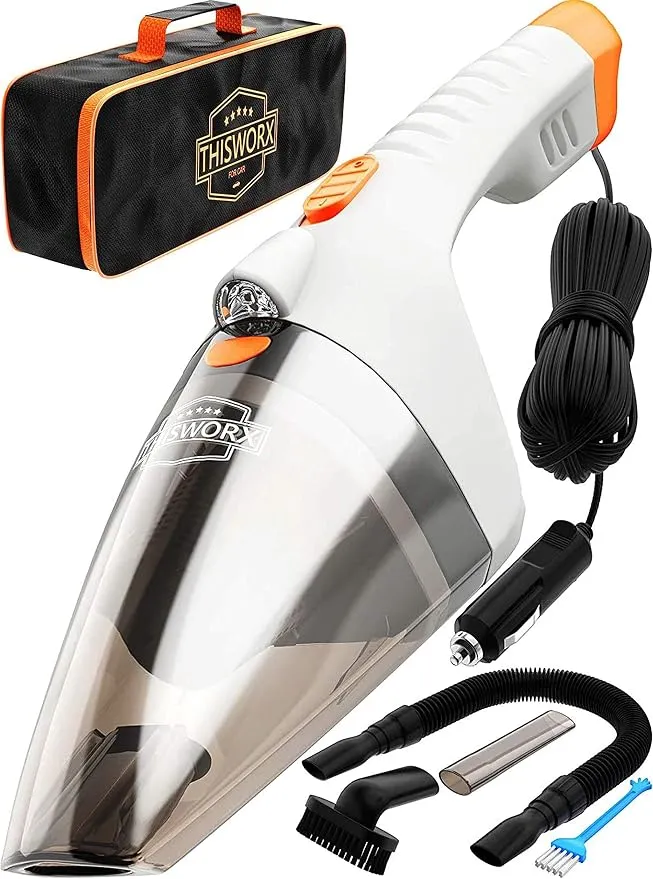
Pros
- Corded — no fade partway through an interior
- Flexible nozzle and crevice tool reach seat rails and console gaps
- Washable filters, so no ongoing consumable cost
- Cheap enough that the expectations bar is easy to clear
- 16ft cord genuinely reaches the trunk on most cars
Cons
- Suction is modest next to a household canister vacuum
- Needs a 12V socket that stays live with the ignition off — not all cars do
- Budget build; the nozzle joint is the usual failure point
- Struggles with embedded pet hair and ground-in grit
- Noisy relative to its power
This is the best-selling car vacuum on Amazon, which is a fact about marketing reach as much as about the product. It is worth being clear about what you’re buying.
What it gets right
It is corded, and that is the correct decision.
Cordless handhelds are more pleasant to hold and consistently disappoint in this specific job. A proper interior — seats, rails, footwells, trunk, console gaps — takes longer than most cordless units sustain at full suction. They fade precisely when you reach the awkward parts, and there is no way to recharge mid-job without abandoning it.
A corded 12V unit runs at the same power for as long as you want. For a car vacuum, consistency beats peak suction, and this is the design decision most reviews skip past.
The filters are washable. No consumable cost, indefinitely. At this price that is a better decision than it needed to be.
The 16ft cord is honest. It genuinely reaches the trunk on most cars from the front socket, which is the actual requirement.
Where it falls down
Suction is modest. Against a household canister vacuum it is clearly weaker. For dust, sand, crumbs and surface debris it is entirely adequate. For pet hair woven into carpet pile, or grit that has been ground in over a winter, it will not lift the material on its own — you need a rubber pet-hair brush or a stiff brush to agitate it loose first, and then the vacuum can take it.
Build quality is what you paid for. The nozzle joint and switch are the parts people report failing. This is a consumable tool. Buying it with that expectation makes it a reasonable purchase; buying it expecting a decade of service does not.
The compatibility trap
Check whether your car’s 12V socket stays live with the ignition off. Many modern cars cut it, and a corded vacuum is useless if you have to run the engine to power it — which is unpleasant and, in a closed garage, genuinely unsafe.
If yours cuts power, either run a mains-powered vacuum with an extension lead, or buy the cordless version instead and accept the runtime limit. This is the single most common cause of disappointment with any 12V car accessory, and it is not the product’s fault.
Using it well
The vacuum is the first step, always, and it is a dry step. Any liquid introduced before vacuuming turns dust into mud and works it deeper into the pile.
- Top down. Headliner, seats, then footwells, then trunk. Everything you dislodge falls downward.
- Agitate first on carpet. A stiff brush or rubber pet-hair brush lifts embedded material into the pile where suction can reach it. This does more for the result than a more powerful vacuum would.
- Crevice tool along seat rails. This is where the grit that scratches trim lives.
- Empty it often. A part-full canister on a small handheld measurably reduces airflow.
The full sequence is in our interior detailing guide.
Should you buy it?
Yes, if you want a dedicated car vacuum that lives in the trunk, you have a 12V socket that stays live, and you understand it is a budget tool for loose debris.
No, if you have pets that shed heavily, your car’s socket dies with the ignition, or you already own a household vacuum with a hose long enough to reach the driveway — in which case you have a better tool already and should spend the money on interior chemistry instead.
Frequently asked questions
Is the ThisWorx car vacuum powerful enough?
For loose dust, crumbs, sand and surface debris, yes. For embedded pet hair or grit ground into carpet pile, no — you will need a rubber pet-hair brush to lift the material first, or a household vacuum with a beater bar. Judge it as a detailing tool, not a replacement for a proper vacuum.
Corded or cordless for a car vacuum?
Corded, in most cases. Cordless is more pleasant for the first few minutes, then fades exactly when you reach the awkward areas under the seats. A car interior takes longer to do properly than most cordless handhelds sustain at full suction, and there is nowhere to recharge mid-job.
Will it work if my car's 12V socket turns off with the ignition?
No, and this catches people out. Many modern cars cut power to the 12V socket when the ignition is off. You can run the car, which is unpleasant in a closed garage, or use a 12V-to-mains adapter. Check your car before buying a corded unit.
How long does it last?
Reported lifespans vary widely, which is what you would expect at this price. Treat it as a consumable that will likely need replacing every couple of years with regular use, rather than a tool you buy once. The nozzle joint and the switch are the common failure points.
Do the filters need replacing?
No — the filters are washable, which is one of the genuinely good decisions in this design. Rinse them, let them dry completely before reassembly, and the running cost is zero. A damp filter reinstalled will smell and reduce airflow.