Blog
Do Tire Dressings Damage Tires?
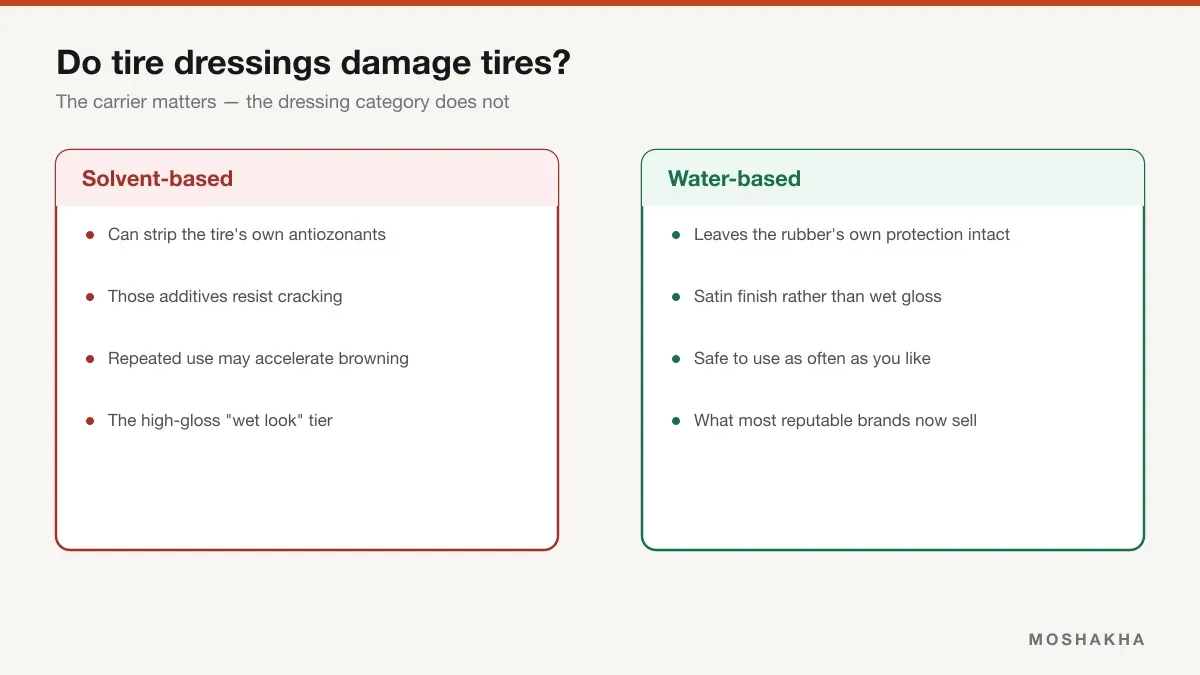
The carrier matters, not the category. Solvent-based dressings can strip the rubber's own anti-cracking additives — water-based ones leave them intact.
“Tire shine rots your tires” is one of the more persistent claims in car care. Like most persistent claims, it’s a distorted version of something real.
The tire protects itself, chemically
Rubber compounds include antiozonants — protective additives that slowly migrate to the surface and shield it from ozone and UV, which are the actual causes of sidewall cracking.
That migration is also why tires develop a brown film. Most people read that as dirt and scrub it off. It’s the tire’s own protection arriving where it’s meant to be.
Where the real risk sits
Not in the silicone. In the carrier.
Silicone suspended in a water-based carrier is harmless to rubber. The same silicone in an aggressive petroleum solvent is a different proposition, because the solvent can leach out those antiozonants faster than the tire replenishes them from its finite internal supply.
Over years of repeated application, that’s a plausible mechanism for accelerated browning and, eventually, cracking. Over a season, on a car you wash monthly, it’s a marginal concern.
This is why “silicone-free” marketing tends to miss the point — it names the wrong ingredient.
Telling them apart
Water-based: water listed first, satin rather than mirror finish, washes off your hands easily, low odor.
Solvent-based: strong petroleum smell, high-gloss wet look, stubborn on skin.
The glossiest “wet look” products are almost always solvent-carried. That’s the tradeoff being made — appearance for carrier aggression.
See the tire gel we reviewedOur pick in best tire shine is a gel applied with a pad rather than a spray — which also solves the separate problem of overspray landing on your brake discs and paint. Full assessment in the Endurance review.
Stop scrubbing the brown off aggressively
The instinct to attack browning with a strong degreaser every wash removes protection the tire then has to rebuild from a limited reserve.
A pH-neutral cleaner, normal agitation, and a sensible wash cadence keep tires looking right without stripping them. If you’re using an acidic wheel cleaner nearby, keep it off the rubber — the reasoning is in wheel cleaner pH.
Keep it in proportion
Age, UV exposure, heat cycling, and chronic under-inflation cause vastly more sidewall cracking than any dressing does. A water-based dressing used normally is not a meaningful risk to your tires.
Checking pressure regularly does more for tire life than every dressing decision combined — see how to check tire pressure, and best tire inflators for the tool that makes doing it monthly realistic rather than a trip to a garage forecourt.
Frequently asked questions
Are silicone tire dressings bad for tires?
Silicone itself isn't the problem — the carrier it's suspended in is. Silicone in a water-based carrier is entirely fine. Silicone in a strong petroleum solvent is where the concern lies, because the solvent can leach out the antiozonants that the rubber relies on to resist cracking. 'Silicone-free' marketing often misidentifies which ingredient actually matters.
What are antiozonants and why do they matter?
They're protective compounds compounded into the rubber that migrate slowly to the surface and shield it from ozone and UV, which are what cause sidewall cracking over time. That gradual migration is also what causes the brown film that appears on tires — often mistaken for dirt. Aggressive solvents can strip these compounds faster than the tire replenishes them.
Why do my tires turn brown after cleaning?
That browning is usually antiozonants migrating to the surface, which is the tire protecting itself working as designed. Repeatedly scrubbing it off with harsh cleaners removes protection the tire then has to replace from a finite internal supply. A pH-neutral cleaner and a normal wash cadence manage the appearance without stripping the protection.
How can I tell if a dressing is water-based or solvent-based?
Water-based products list water as the first ingredient, typically produce a satin rather than mirror finish, and rinse off hands easily. Solvent-based ones smell strongly of petroleum distillates, deliver a high-gloss wet look, and are noticeably harder to wash off skin. The very glossiest 'wet look' products are almost always solvent-carried.
Does tire dressing cause sidewall cracking?
Not on its own, and normal use of a water-based dressing doesn't meaningfully contribute. Repeated use of an aggressive solvent-based product over years can accelerate the process by depleting the tire's protective compounds. Age, UV exposure, heat cycling and under-inflation cause far more cracking than dressing choice ever does.